Social Networks | Week 9
Session: JULY-DEC 2023
Course Name: Social Networks
Course Link: Click Here
These are Nptel Social Networks Week 9 Assignment 9 Answers
Q1. Consider the degree distribution graph plotted with degree of nodes along x axis and percentage of nodes with that degree along y axis. Given a graph with 500 nodes and edges with probability 0.5, where does this graph peak?
250
10
100
400
Answer: 250
Q2. Consider we have a set ‘A’ of 10 random numbers chosen uniformly at random from 10 to 100. What would be the minimum possible value of the sum of all the elements in set ‘A’?
100
10
110
1000
Answer: 100
Q3. For the given graph of weblinks distribution, what does section A represent?
There are no nodes with very low incoming degree
There are nodes with very high incoming degree
Cannot say
There are nodes with high outdegree
Answer: There are nodes with very high incoming degree
These are Nptel Social Networks Week 9 Assignment 9 Answers
Q4. Select all the options that is/are true for power law?
For a variable k,f(k)=1kα where α is a constant
plotting k along x axis and f(k) along y axis results in a straight line
For a variable k,f(k)=kα ,where α is either 2 or 3
plotting log(k) along x axis and log(f(k) along y axis results in a straight line
Answer: A, D
Q5. Consider the given network K, which of the following nodes does a new node ‘X’ entering the network choose to form an edge according to preferential attachment?
A
B
C
D
E
F
Answer: B
Q6. Consider the network K in Question 5, if we have a node that has to attach preferentially to three other nodes, what are the nodes chosen?
A
B
C
D
E
F
Answer: B, D, E
These are Nptel Social Networks Week 9 Assignment 9 Answers
Q7. In the given graph H, each node represents a student and each edge represents a friendship. A new student X joins and makes 2 new friendships. With what probability does everyone have 2 friendships? (it is assumed that X makes both of its friendships simultaneously)
(1/16)*(2/16)
(1/16)*(1/16)
(2/16)*(2/16)
(0/16)*(1/16)
Answer: (1/16)*(1/16)
Q8. What is the probability P for the Erdos Renyi model?
probability of a node to have self loop
probability that two nodes are connected by an edge.
probability that a node has a different attribute.
probability that a node belongs to a specific community.
Answer: probability that two nodes are connected by an edge.
These are Nptel Social Networks Week 9 Assignment 9 Answers
Q9. What is the resultant distribution for Erdos Renyi model and Barabasi Albert model respectively?
normal, normal
normal, power law
power law, normal
power law, power law
Answer: normal, power law
These are Nptel Social Networks Week 9 Assignment 9 Answers
Q10. In a random network, whether the nodes were removed randomly or selectively, the number of nodes to be removed to make the graph disconnected is similar. What are the possible reasons for this behavior?
Network has hubs
edges to this network were added preferentially
edges were added randomly
Network is dense
Answer: edges were added randomly
These are Nptel Social Networks Week 9 Assignment 9 Answers
More Weeks of Social Networks: Click here
More Nptel Courses: Click here
Session: JAN-APR 2023
Course Name: Social Networks
Course Link: Click Here
These are Nptel Social Networks Week 9 Assignment 9 Answers
Q1. Given set E = 1, 2, 3, …, 14,15. We pick a value a1 uniformly at random from this set E. Next, we pick another value a2, again uniformly at random from this set E. Similarly we pick 13 more values, a3, a4, ……, a15 (a total of 15 numbers are picked). Look at the sum S = a1 + a2 + …. + a15. Which of the following sets define the range from which the sum S can have values from?
a. [15, 16, .., 225]
b. [15, 16, .., 150]
c. [15, 16, .., 250]
d. [1, 16, .., 225]
Answer: a. [15, 16, .., 225]
Q2. Which of the following describes the distribution of marks among the students in a class room?
a. Plot the percentage of students along the X axis and marks on the Y axis
b. Plot the student id along the X axis and the marks on the Y axis
c. Plot the marks along the X axis and the percentage of students on the Y axis
d. Plot the marks along the X axis and the student id on the Y axis
Answer: c. Plot the marks along the X axis and the percentage of students on the Y axis
These are Nptel Social Networks Week 9 Assignment 9 Answers
Q3. Which of the following are real world examples of power law distribution?
a. IQ of students
b. Birth weight
c. SAT scores
d. WWW graph
Answer: d. WWW graph
These are Nptel Social Networks Week 9 Assignment 9 Answers
Q4. Identify all the invalid statements for Power law distribution.
a. The characteristic equation for power law is 1/ek
b. power law degree distribution come by in real world networks because of preferential attachment
c. power law degree distribution come by in real world networks because of random attachment
d. The characteristic equation for power law is 1/ka where a is a constant
Answer: a, c
These are Nptel Social Networks Week 9 Assignment 9 Answers
Q5. Consider we have a network of nodes. How does the new incoming node select a node for preferential attachment?
a. Node with maximum number of friends
b. Node with minimum number of friends
c. Node with high clustering coefficient
d. Node with high embeddedness
Answer: a. Node with maximum number of friends
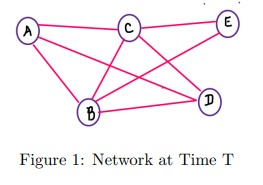
Q6. Given a network being generated by ‘rich get richer’ phenomenon. Figure 1 shows the snapshot of the network at time t. A new node ‘u’ enters the network at time t + 1 and makes an edge with one of the existing nodes. What is the node that has high probability to form an edge with the new node ‘u’?
A
B
C
D
E
Answer: C
These are Nptel Social Networks Week 9 Assignment 9 Answers
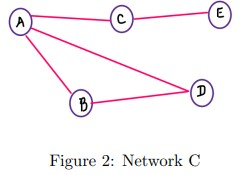
Q7. Given the network ‘C’ of five participants in a competition, a new student ‘F’ joins the team. What is the probability that the new student make friends with A or C or D?
a. 3/10
b. 2/10
c. 2/10
d. 7/10
Answer: d. 7/10
Q8. From the previous example in Figure 2 Network C, F became friends with A.What is the probability that a new incoming student H, makes friends with F?
a. 1/12
b. 2/11
c. 1/11
d. 2/12
Answer: a. 1/12
These are Nptel Social Networks Week 9 Assignment 9 Answers
Q9. For the same Figure 2 Network C, after the addition of node F, assume that a new node G has entered and made friends with A, C and D. What is the probability that any new node I makes friendship with G?
a. 3/14
b. 3/10
c. 3/18
d. 3/17
Answer: c. 3/18
Q10. In a random graph with 500 nodes and edges between any two nodes with a probability of 0.3, where can one expect the peak of the degree-distribution graph?
a. 500
b. 250
c. 100
d. 150
Answer: d. 150
These are Nptel Social Networks Week 9 Assignment 9 Answers
More Solutions of Social Networks: Click Here
More NPTEL Solutions: https://progiez.com/nptel-assignment-answers/