Database Management System Nptel Assignment 2 Answers
Are you looking for the Nptel Database Management System Assignment 2 Answers ? You’ve come to the right place! Our detailed and accurate solutions are designed to assist you in mastering the concepts of DBMS, including SQL queries, database design, normalization, and more.
Table of Contents
Nptel Database Management System Assignment 2 Answers( Jan-Apr 2026)
Que1. Consider two relations EmployeeDept and EmployeeProject as follows.
An operation Θ between EmployeeDept and EmployeeProject will generate the given output. Identify the operation Θ.
a) natural join
b) natural left outer join
c) natural right outer join
d) natural full outer join
Que2. Consider the following CREATE statements for tables department and employee.
Identify the correct statement(s) from the following options.
a) If a dept_id value is deleted from the department table, the corresponding records in the employee table that use this dept_id will also be deleted.
b) If a dept_id value is deleted from the department table, the foreign key constraint will become invalid.
c) If a dept_id value is deleted from the department table, the corresponding records in the employee table that use this dept_id will be deleted and the foreign key constraint will become invalid.
d) If a dept_id value is deleted from the department table, the corresponding records in the employee table that use this dept_id will not be deleted.
Que3. Consider the following table Products.
How many tuples will be returned by the following query?
SELECT product, cost
FROM Products
WHERE cost > (SELECT MIN(cost) FROM Products);
a) 2
b) 3
c) 4
d) 5
Que4. Consider the following table Library.
Which of the following options will NOT be present in the output produced by:
SELECT MAX(book_id) FROM Library GROUP BY category;
a) 3
b) 8
c) 15
d) 21
Que5. Consider the following table Library.
What will be the output of the following SQL query?
SELECT COUNT(book_id)
FROM Library
WHERE category LIKE 'S%' OR category LIKE 'F%';
a) 2
b) 3
c) 4
d) 5
Que6. Consider the following instance of the table Library.
Identify the correct CREATE statement for this table.
a) CREATE TABLE Library (
book_id INT NOT NULL,
category VARCHAR(50),
copies INT,
PRIMARY KEY (book_id)
);
b) CREATE TABLE Library (
book_id INT NOT NULL,
category VARCHAR(50) NOT NULL,
copies INT,
PRIMARY KEY (category)
);
c) CREATE TABLE Library (
book_id INT,
category VARCHAR(50) NOT NULL,
copies DATE,
PRIMARY KEY (category, copies)
);
d) CREATE TABLE Library (
book_id INT NOT NULL,
category VARCHAR(50),
copies INT,
PRIMARY KEY (copies)
);
Que7. Suppose a library wants to create a view consisting of the book_id of books in the ‘Science’ category with the number of copies being greater than or equal to 25 but less than or equal to 40.
Identify the correct query from the following.
a)
CREATE VIEW v1 AS
SELECT book_id
FROM Library
WHERE category = 'Science'
AND copies >= 25 AND copies <= 40;
b)
CREATE VIEW v1 AS
SELECT book_id
FROM Library
WHERE category = 'Science'
AND copies BETWEEN 25 AND 40;
c)
CREATE VIEW v1 AS
SELECT book_id
FROM Library
WHERE category = 'Science'
AND copies > 25 AND copies < 40;
d)
CREATE VIEW v1 AS
SELECT book_id
FROM Library
WHERE category = 'Science'
AND copies >= 25, copies <= 40;
Que8. Consider the following instance of the table Library.
Identify the correct SQL statement(s) to produce the given output.
a)
SELECT * FROM Library
WHERE copies >= 30;
b)
SELECT * FROM Library
WHERE category = 'Science';
c)
SELECT * FROM Library
WHERE copies >= 30 AND category = 'Science';
d)
SELECT * FROM Library
WHERE copies >= 30 OR category = 'Science';
Que9. Consider the following instance of the table Library.
Identify the correct SQL command to find the average number of copies of books in the ‘Science’ category.
a)
SELECT avg(copies) FROM Library;
b)
SELECT * FROM Library WHERE category='Science' AND avg(copies);
c)
SELECT * FROM Library WHERE category='Science' OR avg(copies);
d)
SELECT avg(copies) FROM Library WHERE category='Science';
Que10. Consider the following instance of the table Library.
Identify the correct SQL statement(s) to find the book_id and copies of books whose number of copies is greater than all books in the ‘Fiction’ category.
a)
SELECT book_id, copies
FROM Library
WHERE copies > (SELECT copies FROM Library WHERE category='Fiction');
b)
SELECT book_id, copies
FROM Library
WHERE copies > ALL (SELECT copies FROM Library WHERE category='Fiction');
c)
SELECT book_id, copies
FROM Library
WHERE copies > (SELECT MAX(copies) FROM Library WHERE category='Fiction');
d)
SELECT book_id, copies
FROM Library
WHERE copies > FOR (SELECT copies FROM Library WHERE category='Fiction');
( July-Dec 2025)
Question 1. Consider two relations StudentInfo and CourseEnrollment… Identify the operation ©.
a) Natural join
b) Natural left outer join
c) Natural right outer join
d) Natural full outer join
Question 2. How many tuples will be returned by the query on GameInventory?
a) 1
b) 2
c) 3
d) 4
Question 3. Which game_id will not appear in the output of:SELECT MIN(game_id) FROM GameInventory GROUP BY rarity;
a) G101
b) G205
c) G307
d) G503
Question 4. Which emp_id will appear in the output of the first query but not in the second?
a) E101
b) E205
c) E307
d) E412
Question 5. Which course_code appears in the output of both queries?
a) MATH202
b) PHYS101
c) ECE209
d) CS101
Question 6. Identify the correct CREATE statement for StudentRecords.
a) PRIMARY KEY (student_code)
b) PRIMARY KEY (course)
c) PRIMARY KEY (student_code, department)
d) PRIMARY KEY (department, year)
Question 7. Given RiverDetails relation, what will be the output of the max-length query?
View Answers
Question 8. Identify the correct SQL query to get rivers from China or Egypt.
a) WHERE Country = 'China' OR 'Egypt'
b) WHERE Country BETWEEN 'China' AND 'Egypt'
c) WHERE Country IN ('China', 'Egypt')
d) WHERE Country LIKE 'Ch%' OR 'Egh'
Question 9. Identify the correct SQL query to find RiverName and Country for rivers with length between 2500 and 3000.
a) WHERE Length IN (2500, 3000)
b) WHERE Length AS (2500, 3000)
c) WHERE Length BETWEEN 2500 AND 3000
d) WHERE Length BETWEEN (2500, 3000)
(Jan-Apr 2025)
Course Link: Click Here
- What is the correct SQL query to update the Quantity values in the OrderDetails table where the current values are greater than 2?
- a) MODIFY OrderDetails where Quantity>2;
- b) UPDATE OrderDetails set Quantity=Quantity-1 where Quantity>2;
- c) UPDATE OrderDetails where Quantity>2;
- d) ALTER OrderDetails set Quantity=Quantity-1 where Quantity>2;
- What is the output of the following SQL query for a bookstore system?
SELECT Category, SUM(Quantity) FROM OrderDetails, BookDetails WHERE OrderDetails.BookID = BookDetails.BookID GROUP BY Category;
- a) Fiction: 5, Science: 7
- b) Fiction: 6, Science: 7
- c) Fiction: 9, Science: 7
- d) Fiction: 5, Science: 6
View Answer
- What is the correct SQL statement to create a VIEW for retrieving Name and Price of all products in the ‘Electronics’ category from the ProductDetails table?
- a) Create Electronics_Products AS SELECT Name, Price FROM ProductDetails WHERE Category = ‘Electronics’;
- b) Create view Electronics_Products AS SELECT Name, Price FROM ProductDetails WHERE Category = ‘Electronics’;
- c) Create view Electronics_Products ON ProductDetails SELECT Name, Price WHERE Category = ‘Electronics’;
- d) Create view Electronics_Products TO ProductDetails SELECT Name, Price WHERE Category = ‘Electronics’;
View Answer
- Which of the following options will be present in the output of the SQL query for the DriverDetails table?
SELECT Location FROM DriverDetails WHERE Location LIKE 'B%' AND Location LIKE 'B%';
- a) Bangalore
- b) Bhopal
- c) Pune
- d) Hyderabad
View Answer
- Which relational algebra operation will generate the given output?
- a) OrderDetails NATURAL JOIN ProductDetails
- b) OrderDetails LEFT OUTER JOIN ProductDetails
- c) OrderDetails RIGHT OUTER JOIN ProductDetails
- d) OrderDetails EQUI JOIN ProductDetails ON OrderDetails.ProductID = ProductDetails.ProductID
View Answer
- Which of the following statements is incorrect?
- a) The INSERT command is used to remove/modify rows in a relation.
- b) The UPDATE command is used to modify data (values in rows) of a relation.
- c) The DELETE command is used to remove all data from a relation.
- d) The DELETE command is used to remove a relation entirely.
View Answer
- What will be the output of the following SQL query on the DriverDetails table?
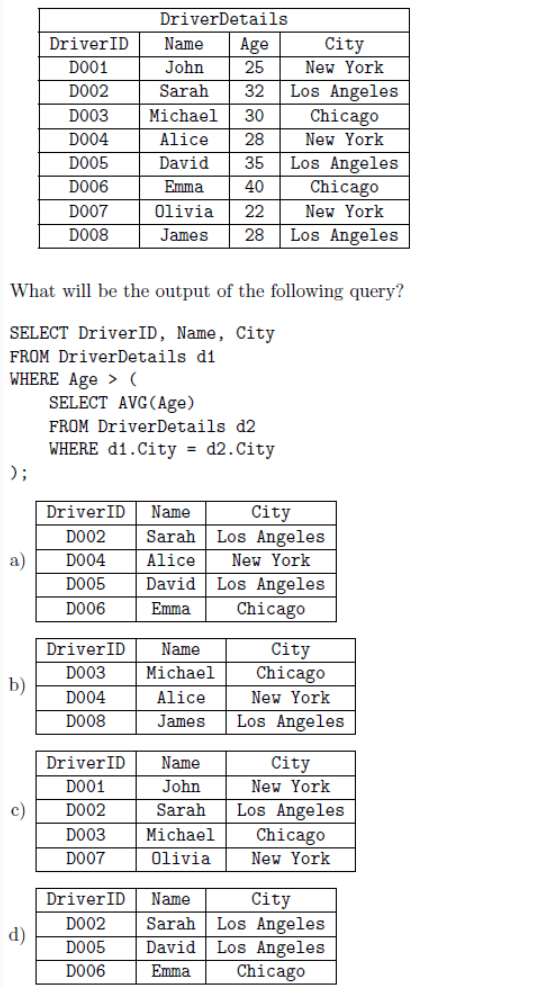
- What will be the output of the following SQL query on the DriverDetails table?
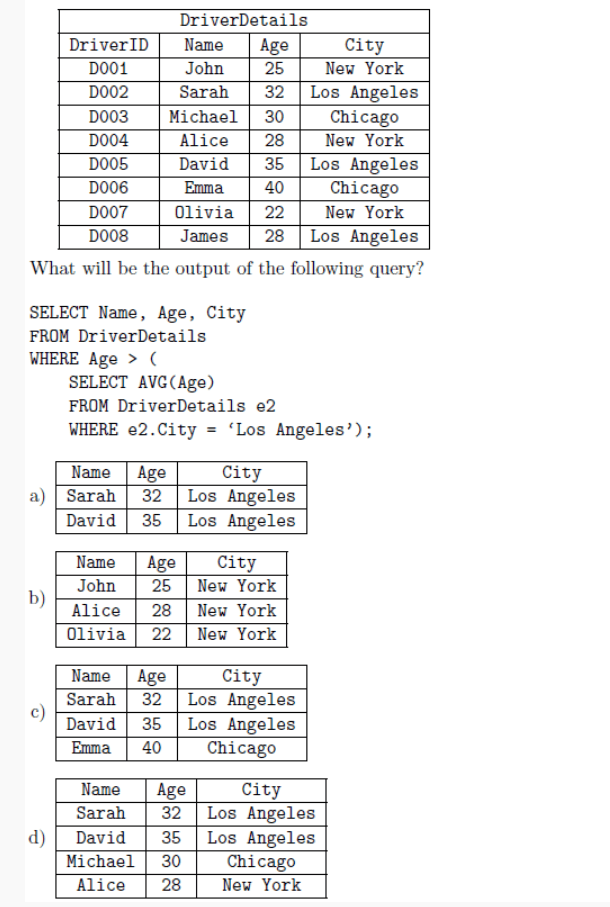
- What will be the output of the following SQL query on the DriverDetails table?
SELECT * FROM DriverDetails WHERE City IN ('New York', 'Chicago');
- a) DriverID: D001, D003, D004, D006, D007
- b) DriverID: D002, D005
- c) DriverID: D001, D002, D003
- d) DriverID: D005, D008
- What is the correct SQL statement to find the DriverID, Name, and City of drivers with an Age between 25 and 35?
- a) SELECT DriverID, Name, City FROM DriverDetails WHERE Age AS (26, 35);
- b) SELECT DriverID, Name, City FROM DriverDetails WHERE Age IN (25, 35);
- c) SELECT DriverID, Name, City FROM DriverDetails WHERE Age BETWEEN 25 AND 35;
- d) SELECT DriverID, Name, City FROM DriverDetails WHERE Age BETWEEN (25, 35);
(July-Dec 2024)
Q1. In a particular messenger application, the instance of Chat Details is as follows:
For the instance, the Total_Text values need to be updated to increase by 500 for those entries whose current values are less than 1000. What is the correct SQL Query for updating the current instance?
a) MODIFY ChatDetails Total_Text=Total_Text+500 where Total_Text<1000;
b) UPDATE ChatDetails set Total_Text=Total_Text+500 where Total_Text<1000;
c) UPDATE ChatDetails Total_Text=Total_Text+500 where Total_Text<1000;
d) ALTER ChatDetails set Total_Text=Total_Text+500 where Total_Text<1000;
Answer: b) UPDATE ChatDetails set Total_Text=Total_Text+500 where Total_Text<1000;
Q2. In a particular messenger application, the instances of ChatDetails and UserDetails are as follows:
What is the output of the following SQL Query?
SELECT COUNT(Address) FROM ChatDetails, UserDetails GROUP BY Address;
a) 4
3
b) 4
8
c) 4
d) 3
Answer: b) 4
8
For answers or latest updates join our telegram channel: Click here to join
These are Nptel Database Management System Assignment 2 Answers
Q3. In a particular messenger application, the instance of UserDetails is as follows:
Which of the options will not be present in the output generated by the SQL query: SELECT Address FROM UserDetails WHERE Address LIKE ‘%’ OR Address LIKE ‘M%’;
a) Agartala
b) Kolkata
c) Mumbai
d) Delhi
Answer: a) ALTER command is used to add remove\modify rows to a relation.
c) DROP command is used to delete all data from a relation.
Q4. Which of the following statements is incorrect?
a) ALTER command is used to add remove\modify rows to a relation.
b) ALTER command is used to add remove\modify attributes to a relation.
c) DROP command is used to delete all data from a relation.
d) DROP command is used to delete a relation.
Answer: a) ALTER command is used to add remove\modify rows to a relation.
For answers or latest updates join our telegram channel: Click here to join
These are Nptel Database Management System Assignment 2 Answers
Q5. Let students (student_id, student name, address, emailid) and enrolment (student_id, dept name, enrolment_date) be two relations in a schema. The primary keys are shown underlined.
Let student_id be a foreign key in enrolment relation referring to students relation. Suppose, there is no violation of the above referential integrity constraint in the corresponding relation instances of students and enrolment.
Which one of the following relational algebra expressions would necessarily produce an empty relation?
a) Istudent_id (enrolment) Istudent_id (students)
b) Istudent_id (students) Istudent_id (enrolment)
c) Istudent_id(enrolment <> students)
d) Istudent_id (enrolment students)
Answer: a) Istudent_id (enrolment) Istudent_id (students)
Q6. Consider the following instance of MountainDetails (MountainName, Altitude, StateName) relation.
What will be the output of the following query?
SELECT MountainName, Altitude
FROM MountainDetails md1
WHERE Altitude = (
SELECT MAX(Altitude) FROM MountainDetails md2 WHERE md1.StateName = md2. StateName);
Answer:
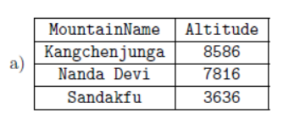
For answers or latest updates join our telegram channel: Click here to join
These are Nptel Database Management System Assignment 2 Answers
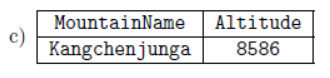
Q7. Consider the following instance of MountainDetails (MountainName, Altitude, StateName) relation.
What will be the output of the following query?
SELECT MountainName, Altitude FROM MountainDetails WHERE Altitude > (
SELECT Altitude FROM MountainDetails WHERE StateName = “Uttarakhand”);
Answer:
Q8. Consider the following instance UserDetails of a messenger application
a) SELECT * FROM UserDetails
WHERE Address AS (‘Delhi’, ‘Mumbai’);
b) SELECT * FROM UserDetails WHERE Address IN (‘Delhi’, ‘Mumbai’);
c) SELECT * FROM UserDetails WHERE Address FOR (‘Delhi’, ‘Mumbai’);
d) SELECT * FROM UserDetails WHERE Address TO (‘Delhi’, ‘Mumbai’);
Answer: b) SELECT * FROM UserDetails WHERE Address IN (‘Delhi’, ‘Mumbai’);
For answers or latest updates join our telegram channel: Click here to join
These are Nptel Database Management System Assignment 2 Answers
Q9.Consider the following instance UserDetails of a messenger application:
Identify the correct statement to create an index on SenderID and Address of UserDetails relation named as ‘View_UserDetails’
a) Create View_UserDetails AS UserDetails (Sender ID, Address);
b) Create index View_UserDetails AS UserDetails (Sender ID, Address);
c) Create index View_UserDetails ON UserDetails (Sender ID, Address);
d) Create index View_UserDetails TO UserDetails (SenderID, Address);
Answer: c) Create index View_UserDetails ON UserDetails (Sender ID, Address);
Q10. Consider the following instance UserDetails of a messenger application:
Identify the correct statement to find the SenderID, Receiver ID, and Address of UserDetails table whose Total_Text is in between 700 and 1200.
a) SELECT SenderID, ReceiverID, Address FROM UserDetails WHERE Total_Text AS (700, 1200);
b) SELECT SenderID, ReceiverID, Address FROM UserDetails WHERE Total_Text IN (700, 1200);
c) SELECT SenderID, ReceiverID, Address FROM UserDetails WHERE Total_Text BETWEEN (700, 1200);
d) SELECT SenderID, ReceiverID, Address FROM UserDetails WHERE Total_Text BETWEEN 700 AND 1200;
Answer: d) SELECT SenderID, ReceiverID, Address FROM UserDetails WHERE Total_Text BETWEEN 700 AND 1200;
For answers or latest updates join our telegram channel: Click here to join
These are Nptel Database Management System Assignment 2 Answers
All Weeks of Database Management System: Click here
For answers to additional Nptel courses, please refer to this link: Check here
(JAN-APR 2024)
Course Name: Data Base Management System
Course Link: Click Here
For answers or latest updates join our telegram channel: Click here to join
These are Data Base Management System Week 2 Assignment Answers
Q1. Consider the following table Collections :
How many tuples will be returned by the following query?
SELECT item, price FROM Collections
WHERE price>(SELECT MIN(price) FROM Collections);
a) 2
b) 3
c) 4
d) 5
Answer: d) 5
Q2. Consider the following table Collections:
Which of the following options will NOT be present in the output produced by
SELECT MAX(cid) FROM COLLECTIONS GROUP BY item;?
a) 11
b) 13
с) 23
d) 2
Answer: a) 11
For answers or latest updates join our telegram channel: Click here to join
These are Data Base Management System Week 2 Assignment Answers
Q3. Consider the following table Delivery:
What will be the output of the following SQL query?
SELECT COUNT (purchaseid) FROM Delivery
WHERE deliverydate LIKE ‘%2011′ AND deliverydate NOT LIKE ’30/’;?
a) 2
b) 3
c) 5
d) 0
Answer: b) 3
Q4. Consider the following instance of table Employee :
Identify the correct, “CREATE” statement for this table.
a) CREATE TABLE Employee (
id int NOT NULL,
lastname varchar(255) NOT NULL,
firstname varchar (255),
age int,
PRIMARY KEY (ID));
b) CREATE TABLE Employee (
id int NOT NULL,
lastname varchar(255) NOT NULL,
firstname varchar (255),
age int,
PRIMARY KEY (ID,lastName));
c) CREATE TABLE Employee (
id int,
lastname varchar(255) NOT NULL,
firstname varchar (255),
age int,
PRIMARY KEY (lastName));
d) CREATE TABLE Employee (
id int NOT NULL,
lastname varchar(255) NOT NULL,
firstname varchar (255),
age int,
PRIMARY KEY (firstname, lastName));
Answer: b)
For answers or latest updates join our telegram channel: Click here to join
These are Data Base Management System Week 2 Assignment Answers
Q5. Consider the two instances:
Which of the following operations will generate the following outputs:
a) BRAND INNER JOIN STATIONARY
b) STATIONARY NATURAL JOIN BRAND
c) BRAND NATURAL RIGHT OUTER JOIN STATIONARY
d) STATIONARY NATURAL LEFT OUTER JOIN BRAND
Answer: a) BRAND INNER JOIN STATIONARY
For answers or latest updates join our telegram channel: Click here to join
These are Data Base Management System Week 2 Assignment Answers
Q6. Consider the following relation instance:
Both attributes Num1 and Num2 are integers and do not have null values. Num is the primary key of the table and Num2 is the foreign key of the same table, Number Tab and references with on delete cascade constraints. A tuple (Num1, Num2) will be in the table only if Num1 ≤ Num2. Which of the following is possible if the tuple (5, 7) is deleted from the table?
a) The deletion of (5, 7) will be prohibited.
b) Tuple (4, 5) and (3, 4) also will be deleted.
c) Tuple (6, 7) and (7, 8) also will be deleted.
d) Only tuple (7, 8) will be deleted.
Answer: b) Tuple (4, 5) and (3, 4) also will be deleted.
For answers or latest updates join our telegram channel: Click here to join
These are Data Base Management System Week 2 Assignment Answers
Q7. Suppose a bank wants to make a view consisting of the names of customers having loan in
‘MUMBAI’ branch with the loan amount being more than equal to 50000 but less than equal to
70000.
• loan (loan number, branch name, amount)
• borrower (customer name, loan number)
Identify the correct query from the following. Primary keys are underlined in the schema.
a) CREATE VIEW v1 AS
SELECT customer_name
FROM loan, borrower
WHERE branch_name = ‘MUMBAI’
AND loan.loan_number = borrower.loan_number
AND amount >= 50000 AND amount <= 70000;
b) CREATE VIEW V1 AS
SELECT customer_name
FROM loan WHERE branch_name = “MUMBAI’
AND amount >= 50000 AND amount <= 70000;
c) CREATE VIEW V1 AS
SELECT customer_name
FROM loan, borrower
WHERE branch_name = “MUMBAI’
AND loan.loan_number = borrower.loan_number
AND amount BETWEEN 50000 AND 70000;
d) CREATE VIEW V1 AS
SELECT customer_name
FROM loan, borrower
WHERE branch_name = “MUMBAI’
AND amount >= 50000, amount <= 70000;
Answer: a), c)
For answers or latest updates join our telegram channel: Click here to join
These are Data Base Management System Week 2 Assignment Answers
Q8. Consider the following instance of StudentDetails(StudName, DeptName, Address, Age) relation.
Identify the correct statements) to get the following output:
a) SELECT * FROM StudentDetails
WHERE Age>=28;
b) SELECT * FROM StudentDetails
WHERE DeptName=^IT’ ;
c) SELECT * FROM StudentDetails
WHERE Age>=28 AND DeptName=^IT’ ;
d) SELECT * FROM StudentDetails
WHERE Age>=28 OR DeptName=^ IT’ ;
Answer: d) SELECT * FROM StudentDetails
WHERE Age>=28 OR DeptName=^ IT’ ;
For answers or latest updates join our telegram channel: Click here to join
These are Data Base Management System Week 2 Assignment Answers
Q9. Consider the following instance of StudentDetails (StudName, DeptName, Address, Age) relation.
Identify the correct SQL command to find the average age of students in the CSE department.
a) SELECT avg(Age) from StudentDetails;
b) SELECT avg(Age) from StudentDetails where DeptName=’CSE’ ;
c) SELECT * from StudentDetails where DeptName=’CSE’ AND avg (Age) ;
d) SELECT * from StudentDetails where DeptName=’CSE’ OR avg(Age) ;
Answer: b) SELECT avg(Age) from StudentDetails where DeptName=’CSE’ ;
For answers or latest updates join our telegram channel: Click here to join
These are Data Base Management System Week 2 Assignment Answers
Q10. Consider the following instance of StudentDetails(StudName, DeptName, Address, Age) relation.
Identify the correct statements) to find the StudName and Address whose Age is greater than the Age of all students in the ‘IT’ department.
a) SELECT StudName, Address from StudentDetails
where Age > (select Age
from StudentDetails
where DeptName = ‘IT’);
b) SELECT StudName, Address from StudentDetails
where Age > all (select Age
from StudentDetails
where DeptName = ‘IT’);
c) SELECT StudName, Address from StudentDetails
where Age > (select max (Age)
from StudentDetails
where DeptName = ‘IT’);
d) SELECT StudName, Address from StudentDetails
where Age > for (select Age
from StudentDetails
where DeptName = ‘IT’);
Answer: b)
For answers or latest updates join our telegram channel: Click here to join
These are Data Base Management System Week 2 Assignment Answers
More Solutions of Data Base Management System: Click Here
More NPTEL Solutions: Click Here
(JAN-APR 2023)
Course Name: Data Base Management System
Course Link: Click Here
These are Data Base Management System Week 2 Assignment Answers
Q1. Table ACCOUNT is created using the following SQL query :
CREATE TABLE ACCOUNT(
AcNo INTEGER,
NAME VARCHAR (20),
PRIMARY KEY (AcNo),
CHECK (NAME LIKE ‘%Y’));
Which of the following SQL command(s) will result in an error?
a) INSERT INTO ACCOUNT VALUES (1, ‘AKSHAY’);
b) INSERT INTO ACCOUNT VALUES (NULL, ‘BIJAY’);
c) INSERT INTO ACCOUNT VALUES (3, ‘ABHAY’);
d) INSERT INTO ACCOUNT VALUES (4, ‘ANANDI’);
Answer: a, c
These are Data Base Management System Week 2 Assignment Answers
Q2. A designer maintains the following relations :
• StyleName (Element, Style)
• PrintStyle (Element, Color)
Which of the following option(s) is/are correct to find the names of the Element that has Style without having any color? Primary keys are underlined in the schemas.
a) SELECT DISTINCTElement
FROM StyleName
INTERSECT
SELECT DISTINCT Element
FROM PrintStyle;
b) SELECT Element
FROM StyleName
WHERE Element
NOT IN
(SELECT Element
FROM PrintStyle);
c) SELECT Element
FROM PrintStyle
WHERE Element
NOT IN
(SELECT Element
FROM StyleName);
d) SELECT DISTINCT Element
FROM PrintStyle
MINUS
SELECT DISTINCT Element
FROM StyleName;
Answer: b) SELECT Element
FROM StyleName
WHERE Element
NOT IN
These are Data Base Management System Week 2 Assignment Answers
Q3. Consider two relations Table1 (A1,A2) and Table2 (A1, A3) as following :
Suppose Table3 (A1, A2, A3) is the output of natural full outer join of Table1 and Table2. Which of the following statement(s) is/are correct?
a) Table3 does not contain (5, 7, null) and (2, 3, 7)
b) Table3 contains (5, 7, 4), (3, null, 7) and (2, 3, null)
c) Table3 contains (5, 7, 4) but not (2, 3, null) and (3, null, 7)
d) Table3 contains (2, 3, 7) and (5, 7, null)
Answer: b, c
These are Data Base Management System Week 2 Assignment Answers
Q4. A designer maintains the following instances:
What is a possible output if the following SQL Query is executed?
SELECT COUNT(LOC) FROM Project, Module GROUP BY LOC;
a) 8
4
b) 12
c) 2
1
d) 3
Answer: c) 2
1
These are Data Base Management System Week 2 Assignment Answers
Q5. Consider the following instance:
What is the output of the following SQL statement?
select distinct Experiment Location from Experiment
where Participant Count in(
select ParticipantCount from Experiment
where Experiment Location=’Lab2′
);
a) Lab2, Lab7, Lab5
b) Lab1, Lab7, Lab5
c) Lab1, Lab2, Lab5
d) Lab1, Lab2, Lab7
Answer: a) Lab2, Lab7, Lab5
Q6. Given the schema (primary key is underlined)
budget (month, expense)
describe the result obtained by the following query.
SELECT MAX(expense) AS exp
FROM budget
WHERE expense < (SELECT MAX (expense) FROM budget);
a) Finds the highest expense from budget.
b) Finds second highest expense from budget.
c) Finds all expenses from budget that are less than the highest expense.
d) Finds all expenses from budget that are equal to the highest expense.
Answer: b) Finds second highest expense from budget.
These are Data Base Management System Week 2 Assignment Answers
Q7. Consider the following instance:
Which of the following output (s) is (are) displayed by the following SQL query?
select NAME from Student
where NAME like ‘%A%’ AND NAME NOT like ‘%Rathod’;
a) Abhay Singh, Roshan Singh
b) Abhay Singh, Roshan Singh, Smriti
c) Smriti, Akshay Rathod
d) Arijit Ray, Abhay Singh, Roshan Singh
Answer: d) Arijit Ray, Abhay Singh, Roshan Singh
These are Data Base Management System Week 2 Assignment Answers
Q8. Consider the following instance of Universities Details (StateName, #Central Universities, #State Universities, #Faculties) relation.
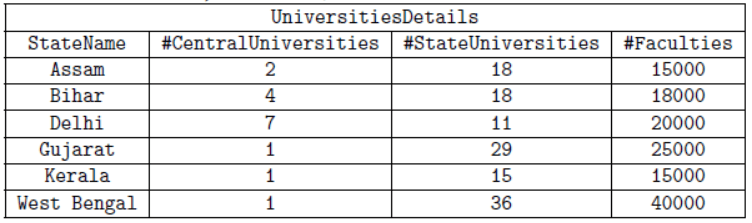
Identify the correct statement(s) to get the following output :
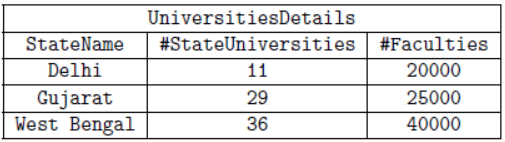
a) SELECT * FROM UniversitiesDetails
WHERE #Faculties>=20000;
b) SELECT StateName, #State Universities, #Faculties FROM Universities Details
WHERE #Faculties>=20000;
c) SELECT StateName, #State Universities, #Faculties FROM UniversitiesDetails
WHERE #Faculties>=20000 AND #Central Universities=1;
d) SELECT StateName, #State Universities, #Faculties FROM UniversitiesDetails
WHERE #Faculties>=20000 OR #Central Universities=1;
Answer: b) SELECT StateName, #State Universities, #Faculties FROM Universities Details
WHERE #Faculties>=20000;
These are Data Base Management System Week 2 Assignment Answers
Q9. Consider the following instance of Universities Details (StateName, #Central Universities, #State Universities, #Faculties) relation.
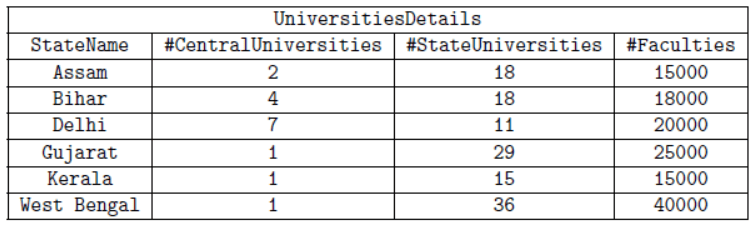
Identify the correct SQL command that creates a view as Universities Info with StateName and #Central Universities that enlist members whose StateName has 2nd character ‘e’.
a) CREATE VIEW Universities Info (StateName, #Central Universities) OF
SELECT StateName, #Central Universities FROM UniversitiesDetails
WHERE StateName LIKE ‘_e%’;
b) CREATE VIEW Universities Info (StateName, #Central Universities) AS
SELECT StateName, #Central Universities FROM Universities Details
WHERE StateName LIKE ‘%e%’;
c) CREATE VIEW Universities Info (StateName, #Central Universities) ON
SELECT StateName, #Central Universities FROM UniversitiesDetails
WHERE StateName LIKE ‘_e%’;
d) CREATE VIEW Universities Info (StateName, #Central Universities) AS
SELECT StateName, #Central Universities FROM UniversitiesDetails
WHERE StateName LIKE ‘_e%’;
Answer: d) CREATE VIEW Universities Info (StateName, #Central Universities) AS
SELECT StateName, #Central Universities FROM UniversitiesDetails
WHERE StateName LIKE ‘_e%’;
These are Data Base Management System Week 2 Assignment Answers
Q10. Consider the following instance of UniversitiesDetails (StateName, #Central Universities, #State Universities, #Faculties) relation.
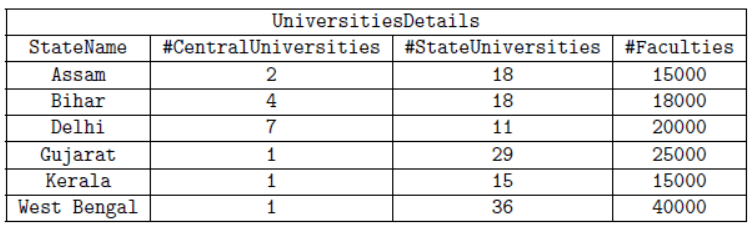
Identify the correct statement(s) to find the StateName whose #Central Universities is greater than or equal to 2 and #Faculties is greater than or equal to 18000 but less than or equal to 25000.
a) SELECT StateName FROM Universities Details
WHERE #Central Universities>=2 AND #Faculties IN (18000, 25000);
b) SELECT StateName FROM UniversitiesDetails
WHERE #Central Universities>=2 AND #Faculties BETWEEN 18000 AND 25000;
c) (SELECT StateName FROM Universities Details
WHERE #Central Universities>=2)
INTERSECT
(SELECT StateName FROM Universities Details
WHERE #Faculties BETWEEN 18000 AND 25000);
d) (SELECT StateName FROM UniversitiesDetails
WHERE #Central Universities>=2)
INTERSECT
(SELECT StateName FROM UniversitiesDetails
WHERE #Faculties AS (18000, 25000));
Answer: b, c
These are Data Base Management System Week 2 Assignment Answers
More Solutions of Data Base Management System: Click Here