The Joy of Computing Using Python Week 1 Nptel Answers
Are you looking for The Joy of Computing Using Python Week 1 Nptel Answers . All weeks of The Joy of Computing Using Python Week 1 Nptel Answerss available here
Table of Contents
The Joy of Computing Using Python Week 1 Nptel Answers (Jan-Apr 2026)
Que1. What will be the final value of counter after the program finishes execution?
a) 8
b) 5
c) 3
d) 10
Que2. What will be the value of score after the first repeat loop ends?
a) 20
b) 24
c) 40
d) 44
Que3. What is the final value of score that the sprite will say?
a) 22
b) 28
c) 34
d) 40
Que4. How many times in total is the change counter by 1 block executed?
a) 3
b) 5
c) 6
d) 8
Que5. Which statement is TRUE about the execution of this Scratch program?
a) The value of score is reset before the second loop
b) The second loop runs before the first loop
c) The sprite says the value of score only once
d) The variable counter is updated only in one loop
Que6. What will be the final value of counter after the program finishes execution?
a) 5
b) 6
c) 8
d) 12
Que7. What will be the value of score immediately after the repeat loop ends (before adding bonus)?
a) 30
b) 36
c) 42
d) 54
Que8. What will be the final value of bonus after the loop completes?
a) 6
b) 9
c) 12
d) 15
Que9. What is the final value of score after the bonus is added?
a) 42
b) 48
c) 50
d) 54
Que10. What message will the sprite display at the end of the program?
a) Excellent!
b) Level Cleared!
c) Try Again!
d) No message
Que11. What will be the final value of battery when the loop stops?
a) 18
b) 14
c) 10
d) 6
Que12. How many times does the repeat until loop execute?
a) 4
b) 5
c) 6
d) 7
Que13. What will be the final value of cycles after the program finishes?
a) 5
b) 4
c) 6
d) 8
Que14. Which statement about the repeat until block is TRUE in Scratch?
a) The loop always runs at least once
b) The loop checks the condition after executing the body
c) The loop behaves exactly like repeat n times
d) The loop stops immediately if the condition is already true
Que15. What message will the sprite display at the end of the program?
a) Battery Low
b) System Shutdown
c) Recharge Needed
d) No message
The Joy of Computing Using Python Week 1 Nptel Answers (July-Dec 2025)
Questions 1-7:
Pixel the Cat’s Mysterious Journey
In the vibrant digital world of Scratchville, lives a clever little cat named Pixel who loves exploring new areas through coding adventures. One day, Pixel stumbles upon a glowing scroll in the Scratch Coding Club’s lab. The scroll contains a strange pattern — a set of step-by-step movement instructions. Curious and excited, Pixel decides to follow them precisely.
Each instruction tells her to move a certain number of steps, wait patiently, and then rotate before continuing. The sequence seems repetitive, but Pixel senses that there’s a hidden purpose — maybe a message, a path, or a challenge.
As Pixel begins her journey, students at the club gather around the screen, watching the curious pattern unfold. Where will she end up? What shape will her path take? Why these specific turns and pauses?
Now, it’s up to you to analyze Pixel’s code-driven adventure and figure out the mysteries it holds… 
Question 1. After following the sequence of movements from the glowing scroll, Pixel ends up back at the exact spot where she started.
a) True
b) False
Question 2. As Pixel follows the instructions from the mysterious scroll, she traces out a specific shape on the ground. What shape does her path form?
a) A square
b) A rectangle
c) A circle
d) A Triangle
Question 3. Based on the shape Pixel traces while following the scroll’s instructions, what is the area covered by her path? (in square units)
a)
b)
c)
d)
Question 4. Suppose Pixel had turned 120 degrees instead of 90 degrees at each turn while following the scroll’s instructions. What shape would her new path form?
a) Rectangle
b) An open figure
c) Hexagon
d) A regular polygon
These are The Joy of Computing Using Python Week 1 Nptel Answers
Question 5. Several students at the Scratch Coding Club try to recreate Pixel’s journey using different blocks. Which of the following Scratch code snippets would produce the same path that Pixel traced in her original adventure?


Question 6. If Pixel follows a new set of instructions written in the Scratch code below, will she return to the same spot where she started?
a) No
b) Yes

Question 7. In the new scenario from the previous question, what shape would Pixel trace as she follows the updated instructions?
a) A Rectangle
b) A Hexagon
c) A Octagon
d) An open figure
Questions 8-12
A man decides to jog and follow the directions given in the scratch code. Initial Position (x=0,y=0, Direction = 90)

Question 8. What is the total distance travelled by the man?
a) 40 units
b) 45 units
c) 50 units
d) 55 units
Question 9. What is the displacement of the man from the starting to the final position?
a) 20 units
b) 15 units
c) 24.5 units
d) 25.5 units
These are The Joy of Computing Using Python Week 1 Nptel Answers
Question 10. In which direction is the man from the initial position at the end?
a) South-East
b) South-West
c) North-West
d) East
Question 11. What is the position of the man after the second “move”?
a) (15, –15)
b) (0, –15)
c) (–10, –25)
d) (−15,−15)
Question 12. How many turns did the man make, and how many of them were to the left?
a) 3 turns, 3 left
b) 4 turns, 2 left
c) 3 turns, 2 left
d) 2 turns, 1 left
Question 13. What are the first two values placed in the sequence variables?
a) x1=1, x2=0
b) x1=0, x2=1
c) x1=1, x2=1
d) x1=0, x2=0
These are The Joy of Computing Using Python Week 1 Nptel Answers
Question 14. How many times does the repeat loop run?
a) 3
b) 4
c) 5
d) It depends on user input
Question 15. Which operation is performed to obtain y inside the loop?
a) x1 + x2
b) x1² + x2²
c) (x1 + x2)²
d) x1 × x2
Question 16. What is the value of x2 after the first pass through the loop?
a) 0
b) 1
c) 2
d) None (it isn’t set yet)
Question 17. Why is the assignment set x1 to x2 necessary?
a) It resets the loop counter
b) It keeps the two-term window sliding forward
c) Without it, the program would crash
d) It shortens the repeat count
These are The Joy of Computing Using Python Week 1 Nptel Answers
Question 18. After the loop finishes, which variable’s value is spoken by the sprite?
a) x1
b) x2
c) y
d) x
Question 19. What kind of control structure is demonstrated by the Repeat block?
a) Recursion
b) Selection
c) Iteration
d) Parallelism
Question 20. Which line makes the algorithm state-changing, rather than read-only?
a) set y to…
b) The repeat header
c) set x1 to x2
d) say x2
Question 21. Suppose the loop were changed to run 1 time instead of 5. What number would the sprite say?
a) 0
b) 1
c) 2
d) It would not speak at all.
These are The Joy of Computing Using Python Week 1 Nptel Answers
Question 22. What broad programming concept does this script best illustrate?
a) Sorting algorithms
b) State machines
c) Numerical iteration
d) Event broadcasting
Question 23. What is the initial value of current and previous when the program starts?
a) Both 1
b) current = 1, previous = 0
c) Both 0
d) They are uninitialized
Question 24. What does the changedFlag variable represent in the code?
a) Whether the value changed
b) The current value
c) The difference between numbers
d) Total changes counted
These are The Joy of Computing Using Python Week 1 Nptel Answers
Question 25. What is the role of the previous variable?
a) It counts how many times the loop ran
b) It stores the value from the last iteration
c) It acts like a flag
d) It adds to the score
Question 26. What kind of variable is changedFlag?
a) Loop variable
b) Copy variable
c) Arithmetic variable
d) Flag variable
Question 27. What is the purpose of setting previous to current at the end of the loop?
a) To reset the loop
b) To compare the new value with the last one in the next iteration
c) To pick a new random number
d) To display the current value
These are The Joy of Computing Using Python Week 1 Nptel Answers
Question 28. How many times does the repeat loop run?
a) Until flag = 1
b) 5
c) 10
d) It depends on the random value.
Question 29. Which block is used to simulate a changing value?
a) set current to 0
b) set current to pick random 1 to 5
c) set previous to current
d) say “Value changed!”
Question 30. When does the sprite say “Same value”?
a) If current is greater than previous.
b) If current is not equal to previous.
c) If current equals previous.
d) If flag is set to 1.
The Joy of Computing Using Python Week 1 Nptel Answers (Jan-Apr 2025)
Course Link: Click Here
1. Which blocks can be used to move the cat?
- A) Walk
- B) Move
- C) Teleport
- D) Glide
These are The Joy of Computing Using Python Week 1 Nptel Answers
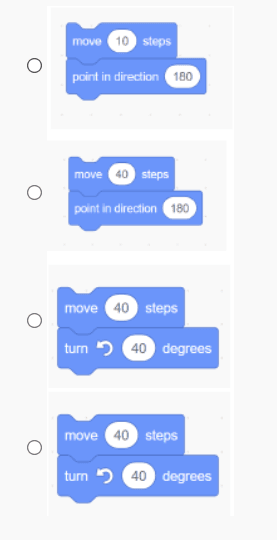
2. Which set of blocks moves the cat 40 steps and then points down?
These are The Joy of Computing Using Python Week 1 Nptel Answers
3. What does the cat say here?
- A) Says the number 7, for 1 second, 7 times, and changes the value of the variable by multiplying the previous value with 1.
- B) Says the number 7, for 1 second, 7 times, and changes the value of the variable by adding 1.
- C) Says the number 7, for 1 second, then numbers from 6 to 1, one by one, for 1 second each.
- D) Says the number 7, for 1 second, then numbers from 6 to 0, one by one, for 1 second each.
4. From the previous question, what is the value of myNum after the loop ends?
- A) 1
- B) 0
- C) 7
- D) Undefined
5. Let the answer from the previous question be stored in variable x. What does the cat say after the execution of the loop?
- A) 16
- B) 5
- C) 29
- D) 2
These are The Joy of Computing Using Python Week 1 Nptel Answers
6. Which of the following data types is primarily used for storing a sequence of characters in most programming languages?
- A) Integer
- B) Float
- C) String
- D) Boolean
7. Which of the following statements best describes why loops are commonly used?
- A) Loops make the code run slower but more reliably.
- B) Loops allow you to execute a block of code repeatedly without having to write it multiple times.
- C) Loops are only useful for error handling.
- D) Loops automatically convert variables from one data type to another.
8. Suppose you have an arithmetic expression involving addition, subtraction, multiplication, and exponentiation. Which statement is true about instructing a computer to evaluate it?
- A) Such expressions cannot be computed.
- B) A computer can only evaluate expressions involving addition and multiplication.
- C) These expressions can be evaluated using built-in operations or libraries.
- D) A computer can only evaluate expressions involving addition and subtraction.
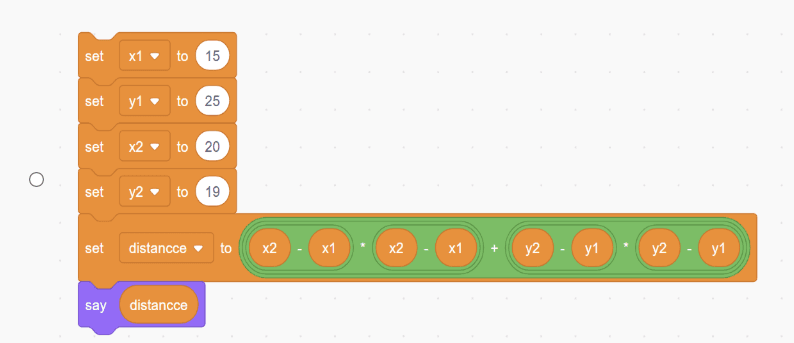
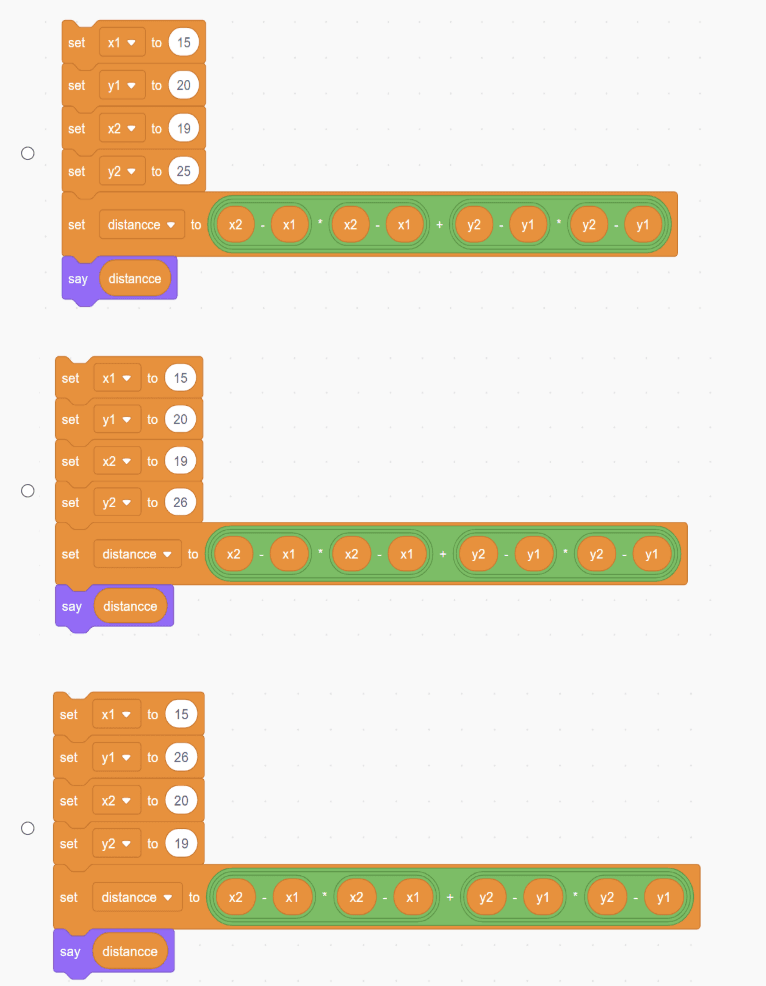
9. In which of the following code blocks is the calculation of the squared distance between two points (15, 25) and (20, 19) accomplished?
10. What task does the block below accomplish?
- A) Moves the ball in a parabolic path and stops 18 steps away from the center (0, 0) in the x-direction.
- B) Moves the ball in a circular path 18 times.
- C) Moves the ball in a parabolic path and stops 18 steps away from the center (0, 0) in the y-direction.
- D) Moves the ball in a parabolic path and stops 17 steps away from the center (0, 0) in the x-direction.
The Joy of Computing Using Python Week 1 Nptel Answers (July-Dec 2024)
Course Link: Click Here
Q1.The cat wants to move 100 steps away slowly, and by the time it finishes moving 100 steps, it needs to slowly rotate as well towards the opposite direction. Can both these tasks be accomplished by using single loop in scratch?
a) Yes
b) No
Q2. Which block moves the cat as described in the previous question ?
Answer: b)
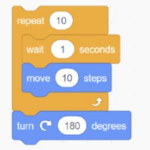
For answers or latest updates join our telegram channel: Click here to join
These are The Joy of Computing Using Python Week 1 Nptel Answers
Q3. What does the cat say here ?
a) Says the number 4, for 1 second, 10 times and changes the value of number variable by multiplying previous value with 4.
b) Says the number 4, for 1 second, 10 times and changes the value of number variable by adding previous value with 4.
c) Says the number 4, and its multiples each for 1 second, till 40 and changes the value of number variable by multiplying previous value with 4.
d) Says the number 4, and its multiples each for 1 second, till 40 and changes the value of number variable by adding previous value with 4.
Q4. From the previous question, what is the value of number variable after the loop ends ?
a) 40
b) 44
c) 36
d) 4
Answer: b) 44
For answers or latest updates join our telegram channel: Click here to join
These are The Joy of Computing Using Python Week 1 Nptel Answers
Q5. Let answer for previous question be stored in variable x, what does the cat say after the execution of the loop ?
16
5
29
44
Answer: 29
Q6. Which of the following is use case of variables in programming.
They are used to make the computer store program data into SSD.
They help in storing and retrieval of information/data while a task on the machine is running.
They simplify a task which involves processing repetitive procedures.They simplify a task which involves processing repetitive procedures.
They help in running multiple tasks parallel to each other.
Answer: They help in storing and retrieval of information/data while a task on the machine is running.
For answers or latest updates join our telegram channel: Click here to join
These are The Joy of Computing Using Python Week 1 Nptel Answers
Q7. What is the concept that helps in instructing the computer to execute repetitive tasks ?
Functions
Variables
Conditionals
Loops
Answer: Loops
Q8. Can polynomial expressions be instructed to computer in logically finite steps ?
Yes
No
Answer: Yes
For answers or latest updates join our telegram channel: Click here to join
These are The Joy of Computing Using Python Week 1 Nptel Answers
Q9. In which of the following code blocks calculation of the squared distance between two points (10, 20) and (35, 49) is accomplished.
Answer: d)
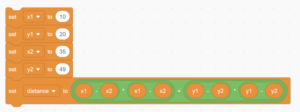
Q10. What task does the block below accomplish ?
Moves the ball in a parabolic path and stops 21 away steps from center(0, 0) in x direction.
Moves the ball in a circular path and 21 times.
Moves the ball in a triangular path and end at the center (0, 0).
Moves the ball in a parabolic path and stops 20 away steps from center(0, 0) in x direction.
Answer: Moves the ball in a parabolic path and stops 20 away steps from center(0, 0) in x direction.
For answers or latest updates join our telegram channel: Click here to join
These are The Joy of Computing Using Python Week 1 Nptel Answers
More Weeks of The Joy of Computing Using Python: Click here
More Nptel Courses: https://progiez.com/nptel-assignment-answers
