Cloud Computing and Distributed Systems Week 1 Answers
Are you looking for Nptel of Cloud Computing and Distributed Systems Week 1 Answers? You’ve come to the right place! Access the most accurate answers at Progiez.
Table of Contents
Cloud Computing and Distributed Systems Week 1 Answers (Jan-Apr 2026)
Que1. A single-site cloud (datacenter) typically includes:
a) Compute nodes, switches, network topology, storage nodes, and a front-end for jobs/requests
b) Only end-user laptops
c) Only a single database server
d) Only Wi-Fi routers and mobile devices
Que2. We describe today’s clouds as having all EXCEPT:
a) Massive scale
b) On-demand access
c) Data-intensive nature
d) Guaranteed single-thread execution
Que3. Which as-a-service model is “flexible compute + storage infrastructure”, often enabled by virtualization?
a) SaaS
b) PaaS
c) IaaS
d) DaaS
Que4. PaaS most closely provides:
a) Bare metal hardware access only
b) A platform/runtime framework to develop and deploy apps
c) Only office productivity software
d) Only network cables and switches
Que5. Virtualization allows:
a) One OS only per machine
b) Concurrent execution of multiple OSs on the same physical machine
c) Eliminating the need for operating systems
d) Only running applications without OS
Que6. The “virtualization layer” is also called the:
a) Compiler
b) Hypervisor / Virtual Machine Monitor (VMM)
c) Cache controller
d) DNS resolver
Que7. Which is true about a Type 1 (bare-metal) hypervisor model?
a) It runs on top of a full host OS
b) It directly manages hardware resources and runs guest VMs above it
c) It cannot support VMs
d) It is only a user-space application
Que8. In x86 hardware without virtualization, the OS must execute privileged instructions in:
a) Ring 3
b) Ring 2
c) Ring 1
d) Ring 0
Que9. In hotspot mitigation for VM migration, a black-box approach is described as:
a) Using OS and application-level statistics
b) Fully OS- and application-agnostic
c) Requiring source-code changes to applications
d) Possible only with para-virtualized guests
Que10. Para-virtualization typically requires modifying approximately:
a) 30% of guest OS code
b) 10% of guest OS code
c) Less than 2% of guest OS code
d) 50% of guest OS code
Cloud Computing and Distributed Systems Week 1 Answers (Jan-Apr 2025)
Course link: Click here
1. Choose the correct items for X, Y, and Z.
X is an example of IaaS, Y is an example of PaaS, and Z is an example of SaaS
- X-Google App Engine, Y-Eucalyptus, Z-Google Docs
- X-Google Docs, Y-Google App Engine, Z-Eucalyptus
- X-Eucalyptus, Y-Google App Engine, Z-Google Docs
- X- Google Docs, Y-Eucalyptus, Z- Google App Engine
Answer :- c
2. Utility computing is a model where service provider
- Makes computing resources available to the customer as needed
- Makes computing resources available to the customer for some amount of time
- Can’t say – implementation dependent
- Maximize revenue
Answer :- a
3. True or False ?
Live migration refers to the process of moving a running virtual machine or application between different physical machines without disconnecting the client or application.
- True
- False
4. True or False ?
Cloud computing is a distributed computing model.
- True
- False
5. Which of these statements are correct?
Statement-1: Moore’s law indicates that processor speed doubles every 18 months.
Statement-2: Gilder’s law indicates that network bandwidth has doubled each year in the past.
- Only statement 1 is correct
- Only statement 2 is correct
- Both statements are correct
- Both statements are false
6. The goals of virtual machine monitor (VMM) are:
- Fidelity
- Performance
- Safety & isolation
- All of the mentioned
7. Which delivery model is an example of a cloud computing environment that provides users access to Virtual Machines?
- Software as a Service (SaaS)
- Infrastructure as a Service (IaaS)
- Platform as a Service (PaaS)
- Application as a Service (AaaS)
8. Which type of Hypervisor is shown in the following figure ?
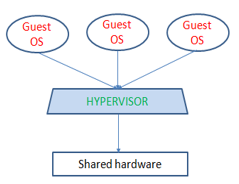
- Type 1
- Type 2
- Type 3
- All of the mentioned
9. Consider the following regarding the Sandpiper architecture:
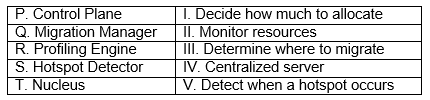
- P: I,Q: II, R:III, S:IV, T:V
- P: III,Q: V, R:I, S:IV, T:II
- P: IV,Q: III, R:I, S:V, T:II
- P: III,Q: IV, R:I, S:V, T:II
10. Which of the following type of virtualization is found in hypervisor such as Microsoft’s Hyper-V ?
- Paravirtualization
- Full virtualization
- Emulation
- None of the mentioned
These are Cloud Computing and Distributed Systems Week 1 Answers
For answers to others Nptel courses, please refer to this link: NPTEL Assignment